Affluent Americans Give More Strategically, But Fewer Are Donating


Americans often expect the wealthy to shoulder a bigger share of charitable giving. But new research suggests fewer affluent households are donating at all.
The “2025 Bank of America Study of Philanthropy: Charitable Giving by Affluent Households,” developed in partnership with the Indiana University Lilly Family School of Philanthropy, found that while overall giving by affluent families has increased by 30% over the past decade, the number of households contributing has fallen.
The biennial study is based on a nationwide survey of affluent households with annual incomes of at least $200,000 or assets of $1 million excluding a primary home. It tracks how affluent donors give, what motivates them and how their habits are evolving.
“This year’s study highlights a desire among affluent Americans to make a real difference — often in their own backyards — by combining financial contributions and active engagement,” Katy Knox, president of Bank of America Private Bank, said in a statement. “It’s inspiring to see so many individuals committed to positive change.”
Here are five key takeaways from the study.
1. Declining Donor Participation Hits the Wealthy, Too
The shrinking donor pool is a long-running observation, often found in the Fundraising Effectiveness Project’s quarterly reports. With fewer donors giving, those who remain are carrying a heavier share of overall individual fundraising totals.
But declining donor participation isn’t limited to small-dollar and mid-level donors. The drop-off includes affluent households as well. Only 81% of affluent households donated in 2024, down from 91% in 2015. That means one in five wealthy families gave nothing last year, but wealthy households gave an average of $33,219 — more than 10 times the giving level of the general population.
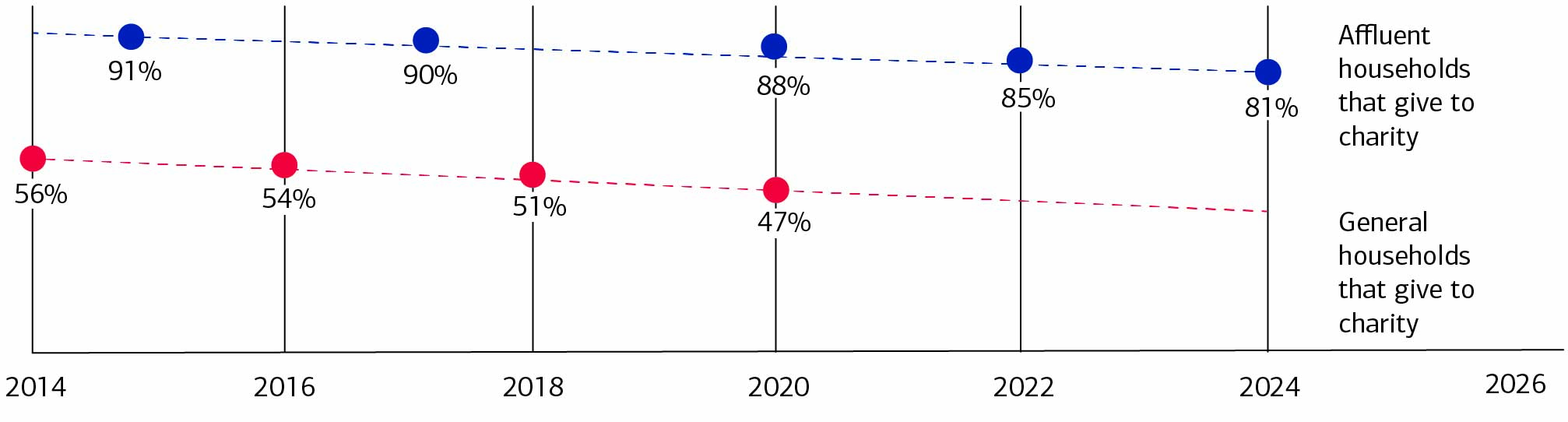
Giving by affluent households declined from 2014 to 2024 by 10 percentage points. | Credit: 2025 Bank of America Study of Philanthropy: Charitable Giving by Affluent Households by Bank of America Private Bank
2. Volunteers Give More
After a pandemic-era low in 2020, volunteerism among affluent Americans rebounded 13 percentage points, a survey reaching 43% in 2024. The study also found those who volunteer give more than twice as much as non-volunteers.
That’s not just goodwill — it’s real economic value. Independent Sector estimates the value of a volunteer hour at nearly $35, underscoring how time contributions translate into significant financial worth for nonprofits.
Still, as NonProfit PRO’s research found, many organizations struggle to recruit and retain volunteers. That tension — between the potential financial and engagement upside of volunteers, and the operational barriers nonprofits face in harnessing them — creates both urgency and opportunity for organizations looking to strengthen donor pipelines.
3. Donors Prefer Local Giving
Affluent households support five organizations on average, but largely prioritize giving close to home, with 79% giving locally. This preference could be an advantage for community-based organizations, especially smaller nonprofits that often rely on grassroots support. Community-building approaches can transform fundraising from transactional to relational and fuel long-term donor loyalty.
4. Strategic Giving Becomes the Norm
Affluent donors are increasingly planning their philanthropy with intention. More than 40% of households now report having a formal giving strategy, and nearly half of couples (46%) make decisions jointly. Multigenerational involvement is still limited, with only 13% including children or grandchildren, but that remains an emerging opportunity.
Giving vehicles — including donor-advised funds, private foundations, wills and giving circles — are becoming more common. In 2024, 18% of gifts were made through these means — up from 11% a decade ago. These structured tools signal a shift from ad hoc giving to carefully managed philanthropy.
5. Donors Want to See Impact
Most affluent donors let their personal values, interest in the cause or firsthand experience guide their giving. But they’re increasingly motivated by outcomes, not just causes. While only 20% of affluent donors actively monitor the impact of their gifts, nearly two-thirds of self-identified “expert” donors evaluate their results. These expert donors also gave six times more than self-identified “novice” donors in 2024.
The study also noted that affluent donors aren’t a monolith. Profiles such as steadfast supporters, devout donors, entrepreneurs, changemakers and philanthropic experts show the diverse ways donors define meaningful impact. For nonprofits, understanding these distinctions can guide stewardship — whether it’s offering detailed reports for experts, innovation opportunities for changemakers or consistent communication for loyal supporters.
“Through this study, we illuminate how affluent donors, advisers and nonprofit organizations navigate today’s changing philanthropy landscape,” Amir Pasic, Eugene R. Tempel Dean at the Indiana University Lilly Family School of Philanthropy, said in a statement “In particular, personal connection and in-depth knowledge are central to the higher levels of engagement with their giving and with nonprofits that we see among more generous donors.”
- Categories:
- Donor Demographics
- Mission Impact
- Volunteers